
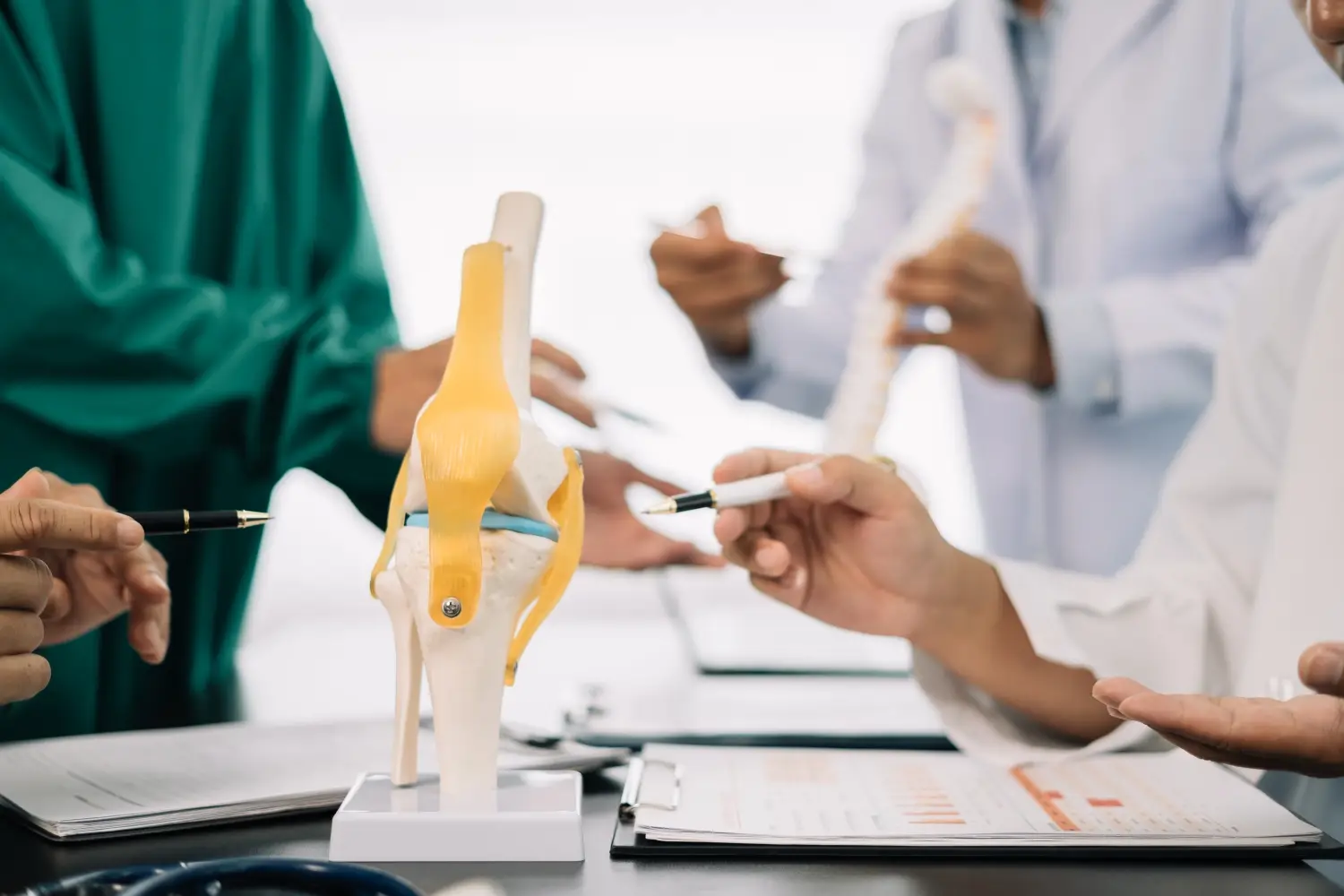

What is total knee replacement?
In a total knee replacement (total knee arthroplasty), an orthopedic surgeon removes the worn cartilage and a thin layer of bone from the end of the thigh bone (femur) and the top of the shin bone (tibia), then caps them with metal components separated by a medical-grade plastic spacer. The back of the kneecap may also be resurfaced.
It is one of the most common and most studied operations in orthopedics. Most patients walk with a walker the day of or the day after surgery.
Who it's for
- Knee pain from osteoarthritis, rheumatoid arthritis or post-injury arthritis that limits walking, stairs or sleep
- Pain that has not improved enough with weight management, physical therapy, anti-inflammatories or injections
- X-rays showing significant joint-space loss or bone-on-bone contact
- Healthy enough for surgery and anesthesia — your surgeon will review heart, lung, diabetes and blood-thinner history
Active infection anywhere in the body, uncontrolled diabetes, or very poor circulation in the leg usually has to be addressed first. Your surgeon decides after reviewing your records.
How much does total knee replacement cost in Mexico?
Written, itemized quote
Priced individually — it depends on your treatment protocol.
You'll get a written, itemized quote after your consultation, so you can compare it line by line with U.S. prices.Your trip, step by step
A typical plan. Your doctor sets the exact schedule and your fit-to-travel date.
Before you travel
Send recent knee X-rays (standing views if possible), medication list and medical history. The surgeon reviews them by video call and confirms you are a candidate.
Day 1
Arrive in El Paso. Your coordinator meets you and escorts you across the bridge to pre-operative labs, EKG and in-person consult.
Day 2
Surgery. Typical hospital stay is 1–3 nights.
Days 3–12
Recovery stay near the hospital with daily walking, physical therapy and wound checks. Blood-clot prevention continues as prescribed.
Around day 12–14
Follow-up visit and clearance to travel. Your surgeon sets the fit-to-travel date.
At home
Outpatient physical therapy near home for several weeks; video follow-ups with your surgeon.
Recovery
- Walker or crutches: typically 1–3 weeks, then a cane
- Driving: usually 4–6 weeks for a right knee, once off opioid pain medicine
- Desk work: often 4–6 weeks; physical jobs longer
- Most of the improvement comes over 3 months; swelling can take 6–12 months to fully settle
Typical ranges. Your recovery depends on your health, the exact procedure and your surgeon's instructions.
Risks to understand
Every operation has risks, wherever it is done. Your surgeon will go through them with you, including how they apply to you.
- Blood clots in the leg or lungs — why clot prevention and walking matter, and why long car rides or flights need planning
- Infection of the joint (uncommon, but serious)
- Stiffness or persistent pain
- Bleeding, nerve or blood-vessel injury
- Loosening or wear of the implant over the long term
Questions to ask your surgeon
- Which implant brand and model will you use, and can I have the implant card?
- How many knee replacements do you perform a year?
- What is your plan for blood-clot prevention during my recovery and trip home?
- What happens if I develop an infection or complication after I am home?
Why get total knee replacement in Ciudad Juárez?
Ciudad Juárez is directly across the border from El Paso. For nearby patients, this can make repeat appointments more practical; others can explore travel through El Paso. The right decision still depends on the provider, your health, and the full care plan.
A domestic flight, not an international one
Fly into El Paso International (ELP) from Texas, New Mexico, Arizona or Colorado. Juárez is a short drive from the airport.
Your doctor stays close
Recover near the hospital, on either side of the border. If you ever need a follow-up visit, it's a short trip, not a flight to Cancún or the West Coast.
Price and language, handled
An itemized quote in writing before you travel, an interpreter at every medical visit, and your surgical report in English.
Patients travel to us from:
Frequently asked questions
Can I have both knees done on the same trip?
Some patients are candidates for bilateral (both knees) surgery, but it carries more risk and a longer recovery. Your surgeon decides after reviewing your health history; many patients do the second knee on a later trip.
How soon can I fly home after knee replacement?
Your surgeon sets the date, commonly about two weeks after surgery. Long flights and car rides raise the risk of blood clots, so you will get specific instructions: walking breaks, compression stockings and any prescribed blood thinner.
Who does my physical therapy when I'm home?
You will leave with a written therapy plan and surgical report in English to hand to a local physical therapist. We can help you line up an appointment before you travel.
Will Medicare or my insurance pay?
Original Medicare generally does not cover planned surgery outside the U.S., and most private plans do not either. Check with your plan; many patients pay out of pocket or use medical financing.
How much does knee replacement cost in Mexico?
Your cost depends on the procedure, the provider, and your individual needs. Request a written, itemized quote that separates clinical fees, tests, travel, accommodation, and follow-up. Confirm the currency, quote validity and costs of possible changes with the provider.
Is knee replacement in Mexico safe?
Safety depends on your health, the proposed procedure, the provider and travel conditions. Verify credentials, discuss individual risks with the clinician, and confirm emergency and follow-up arrangements. No procedure or trip is risk-free. Read the safety guide.
Why consider knee replacement in Ciudad Juárez?
Juárez offers a land-border route through El Paso, including a domestic U.S. arrival for patients flying from within the country. That can help with trip planning and repeat visits, but it does not establish clinical quality or guarantee savings. Compare the provider and complete care plan.
Does the quote cover partial or total knee replacement?
Ask the surgeon to identify the proposed operation, knee, implant and hospital in writing. The assessment determines the appropriate procedure. Confirm whether the quote includes anesthesia, tests, hospitalization, walking aids and rehabilitation; these should not be assumed from the procedure name alone.
How do I arrange physical therapy after knee surgery in Mexico?
Discuss rehabilitation before choosing travel dates. Ask who provides the initial therapy, what information your therapist at home will receive, and which visits require returning to the surgeon. Include therapy, transport and help at home in the overall plan.
When can I drive or fly home after knee replacement?
Your treating team must give individual travel clearance. Distance, mobility, the operation and your health affect the plan. Request written advice about assistance, sitting, walking and follow-up, and keep your return booking flexible rather than relying on a standard package length.
Related treatments
Clinical background & further reading
General planning information, not medical advice. Your treating professional determines suitability, treatment, recovery, and travel clearance.